

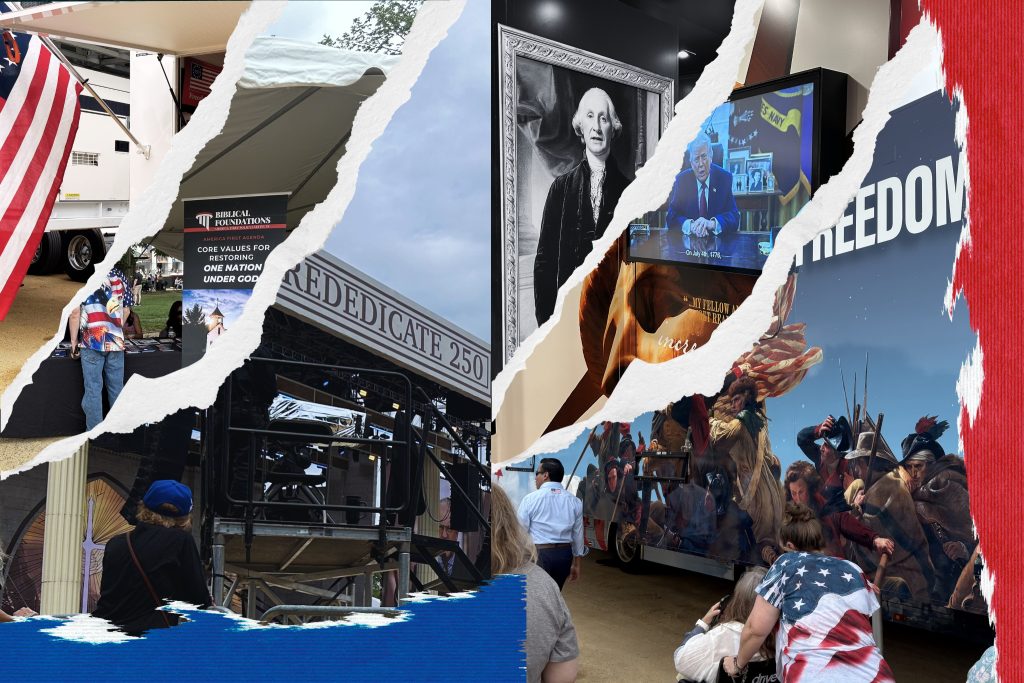
A nine-hour government prayer service rededicated the country to God on the National Mall, the first of 16 Freedom 250 events before July 4. Its speakers embraced the Christian nationalist label. The president skipped it to golf.
What this story tracks
- The denial collapses. Promoted as a celebration of religious freedom for all, the rally instead had Robert Jeffress embracing the “Christian nationalist” label outright.
- A government church service. A federal initiative built a Mall stage shaped like a federal building, fitted it with a stained-glass cross, and beamed in video messages from Cabinet secretaries.
- The absent president. Trump spent the day golfing in Virginia, reaching his own rededication only through a recycled video of himself fumbling a Bible verse.
- The dominionist substructure. The event is the public face of the Seven Mountain Mandate, the doctrine that Christians must occupy government, media, and education.
- The slush fund. A watchdog group is suing the Interior Department for records that would show whether $100 million was diverted to Freedom 250 without congressional approval, access to the president was sold for $2.5 million, and foreign donations were solicited at Davos.
Robert Jeffress reached the point in the speech where the disclaimer usually goes, and skipped it. The Dallas megachurch pastor told the crowd on the National Mall that the men who signed the Declaration of Independence “would be called Christian nationalists today,” and that the label was “a title they would have gladly embraced.” Then he claimed it for himself. If being a Christian nationalist meant loving Jesus Christ and loving America, he said, “Count me in.” The crowd roared. The White House had promoted the day as a celebration of religious freedom for all. From the stage, the featured pastor named it something else.
One attendee put the day’s logic more plainly than the program did. People misunderstand the separation of church and state, he told a reporter on the Mall: “We don’t want the government intervening in the church, but we do want the church intervening in the state.” That was the event in a sentence. For nine hours on May 17, the speakers asked the federal government to install the church inside the state, and they asked it from a stage the federal government had paid to build.
“Rededicate 250: A National Jubilee of Prayer, Praise & Thanksgiving” drew thousands to the Mall, the first of 16 Freedom 250 events scheduled before the Fourth of July. Organizers ran it through Freedom 250, the public-private body the White House created to stage the Semiquincentennial without the oversight that binds the congressionally chartered America250 commission. Set designers dressed the platform as a federal building and fitted it with stained-glass windows of the founders flanking a white cross. On that stage, jumbo screens displayed video messages from senior federal government officials.
Franklin Graham opened the indictment. America had become “morally rotten, completely sick with sin,” he said, with “transgenderism, same-sex marriage, opening women’s locker rooms to men” offered as “just the tip of the iceberg.” Two and a half centuries ago, he noted, the Bible was taught in public schools; now it has been evicted from schools and “for the most part, the public square.” What he wanted was conversion. He asked the country to repent and be “born again,” from a stage federal money had helped build.
History was Eric Metaxas’s assignment. He retold George Washington’s 1776 retreat across the East River, rescued in his telling by a providential fog, “that is not Christian history, that is American history.” Water ran through the speech as the instrument of divine deliverance, from the Red Sea to the Delaware. Then he reached the present and the new ballroom going up at the White House, which he said had waited “two centuries for the Lord to raise up a great man” to build it. The great man went unnamed. He did not need naming.
Larry Arnn, president of Hillsdale College, took the lectern and acknowledged the charge against the event. “This very meeting,” he told the crowd, “is criticized as an attempt to turn America into a Christian nation.” He moved from there to Lincoln’s second inaugural, urging the country to remember its shared purpose. Hillsdale has spent decades training a generation of conservative officials and judges, and it teaches the founding as a Christian inheritance. Its president’s slot at a federal rededication was a placement, not happenstance.
The opening prayer set the register. Samuel Rodriguez told the Mall that American politics is not really about “the donkey and the elephant” but about “the serpent and the lamb.” Carlos Campo, of Regent University, preached the fall of Jericho and counted the crowd down to a battle shout. None of the speakers asked for a place in the country’s civic life. They asked to run it.
None of this is improvised. The Seven Mountain Mandate, the dominionist doctrine that Christians are called to take the commanding heights of government, media, education, and four other spheres of society, provides the theology underpinning an event like Rededicate 250. Its modern popularizer, Lance Wallnau, told his audiences in 2016 that Trump was a “Cyrus” figure, a flawed ruler chosen by God to deliver his people. Followers who accept that frame answer doubts about Trump’s conduct by quoting scripture about God’s use of broken vessels. The pastors who filled the Mall stage on May 17 belong to that tradition.
The day before the official program, the same movement held a less guarded version. Sean Feucht, the worship leader whose Roots of Revival tour announced in February that it was “officially partnering” with Freedom 250 and the White House Faith Office, staged his own service near the Washington Monument on May 16. After months of partnership, the administration now files that event under unaffiliated. The change came after Feucht’s headliner became a problem: Mark Driscoll, the scandal-plagued former Mars Hill pastor, whom the White House swore it had never invited to the Sunday stage. Feucht’s bill also featured Greg Locke, a Tennessee preacher known for burning books and for speaking in Washington the night before the January 6 attack.
Driscoll, given his own stage, preached exactly the sermon that the official program had been built to keep off-camera. He told the “young men” in the crowd to submit to Christ, marry, and “have more children than you can afford” so as to raise “future gladiators for the kingdom of God.” Young women, he explained, had been “brainwashed to hate Jesus Christ” and to “reject femininity.” He called for “more fathers and less government.” Then came a working session on how to take it. Nate Schatzline, a Republican Texas state representative who pastors at Mercy Culture Church in Fort Worth, told the crowd he had won his seat through a worship service and gone on to flip 133 more. Schatzline runs For Liberty & Justice, a 501(c)(3) organization, the Texas Observer reported, that has organized volunteers for Ted Cruz and other Republican candidates while publishing slates of “Friends & Family” contenders. In October, he announced he was leaving the legislature at the end of his term to join the National Faith Advisory Board, the White House body chaired by Paula White-Cain that produced the program a day later on the Mall. Mercy Culture’s senior pastor, Landon Schott, already sits on its Spiritual Advisory Board. The two stages on the Mall that weekend ran out of the same office.
The president showed up to neither stage . While his Cabinet rededicated the country to God, Trump spent the afternoon at his golf club in Sterling, Virginia. He reached the Mall only on video, and not a new video: organizers replayed a three-minute clip recorded in April for the Museum of the Bible’s “America Reads the Bible” event. In it, Trump reads 2 Chronicles 7 haltingly, by one account “barely able to pronounce his words correctly.” Between holes, he posted on Truth Social, in all caps: he hoped everyone at Rededicate 250 was having a good time; he asked the wife of his transportation secretary to call him; and he announced that he was back from China. Hours later, on the same feed, he warned that there would soon be “nothing left” of Iran. House Speaker Mike Johnson appeared in person and led the closing prayer. Vice President JD Vance, Marco Rubio, Pete Hegseth, and Tulsi Gabbard appeared on screen, like the president.
Of every name on the program, only one, Orthodox rabbi Meir Soloveichik, was not Christian. The Council on American-Islamic Relations noted that no Muslim appeared at all.
Six in ten Americans, a Pew survey found, believe the founders intended a Christian nation. The Constitution they wrote does not mention God, bars religious tests for office, and opens by locating power in the people. Rededicate 250 spent nine hours teaching the version most Americans already think is true.
Faith leaders objected too. Bishop William Barber, who convened a counter-event called Redirect 250, refused even to grant the rally the label “Christian nationalism.” “This is idolatry, this is heresy,” he said. “This is Trump worship.” He noted that the Mall stage never mentioned Jesus and never mentioned justice, and that the verse Trump read condemns those who hurt the poor. Sarah Posner, who has covered white Christian nationalism for two decades, told “Democracy Now” the rally was about whether Americans would accept “the religion of Mike Johnson and Paula White” being imposed on the rest of the country. Barber pointed to the 22-foot gilded statue of Trump, fists raised, recently unveiled at Trump National Doral, which one pastor defended by insisting it was “not a golden calf.” Barber said it was a golden image, the kind Nebuchadnezzar raised and ordered a nation to bow before.
Freedom 250, funded in part by federal money, operates as a subsidiary of the National Park Foundation, the National Park Service’s fundraising arm, and it ran a sectarian worship service on federal parkland with a budget that blends private donations and public money. On May 11, the watchdog group Public Employees for Environmental Responsibility (PEER) sued the Interior Department in federal court in Washington for refusing to answer FOIA requests filed in February.
PEER’s requests seek records of $100 million allegedly diverted to Freedom 250 from the congressionally chartered America250 commission without congressional approval, access to the president sold for up to $2.5 million, foreign donations solicited by Freedom 250 CEO Keith Krach at the World Economic Forum in Davos, and Interior employees pressured to add Freedom 250 logos to their official email signatures, a possible Hatch Act violation. Tim Whitehouse, PEER’s executive director, called the entity “a privately managed slush fund designed to operate with no transparency, no accountability, and no guardrails.” Interior Secretary Doug Burgum, who oversees the National Park Service, has not released any of the requested records.
