

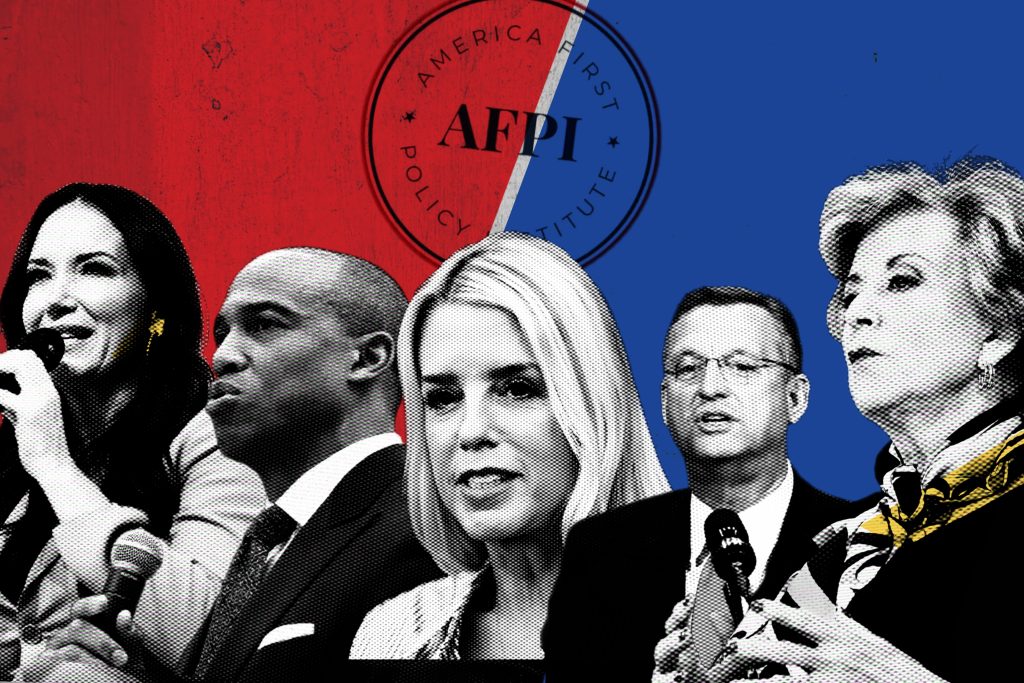
As part of a special four-part series on the influence that far-right think tanks have on the new Trump administration, the Global Project Against Hate and Extremism (GPAHE) has analyzed the staff connections at the oft-called Trump “White House in waiting,” the American First Policy Institute (AFPI). GPAHE created a database of senior officials and members of the boards of directors of organizations tied to AFPI, and those in their proximity, in order to document their relationships with other pro-Trump organizations, and calculate the extent of their “influence” in the administration (for more on GPAHE’s methodology, see the note at the bottom of the text).
AFPI was formed after Trump’s 2020 presidential loss, hiring many individuals who served in the first Trump administration. The goal was to organize a very well-financed “shadow transition operation” to vet far-right, pro-Trump individuals for the second administration. The pro-Trump dark money group affiliated with the AFPI is America First Works.
AFPI has been uncompromising in their support of Trump’s agenda, defending him during his many court cases, calling for the removal of LGBTQ+ and “woke” material from public schools, and working toward the dissolution of the Department of Education. AFPI has made clear their desire for a theocratic state based on Christian nationalist principles in their handbook, “Biblical Foundation,” where they refer to the U.S. as “a nation founded by people rooted in Biblical truth,” and claim to seek to “maintain the [country’s] foundational Judeo-Christian values,” and call on the Church to “engage in the issues of the day” to “bring the Kingdom of Heaven to Earth.”
Since Trump’s return, AFPI principals have enjoyed significant influence in the administration, and according to reporting, officials still with the think tank are refocusing their efforts on preparing a “100-year plan” to maintain Trumpism long after he leaves office.
In the broader pro-Trump network of think tanks, AFPI is one of the most influential nodes in the entire dataset. Unlike Project 2025 affiliated organizations, AFPI includes few individuals who contributed to Project 2025’s 900+ page Mandate for Leadership, which laid out a detailed policy plan for Trump that is now being enacted. The exception to this are AFPI principals John Ratcliffe, a former Trump official who was nominated to be director of the Central Intelligence Agency (CIA), James Baehr, a former special assistant to the president in the Domestic Policy Council (DPC), Jon Sanders, formerly a senior fellow at the AFPI’s Center for American Prosperity, and Ambassador to Denmark Carla Sands, all of whom are listed as contributors to the Project 2025 plan.
AFPI is well-connected to other influential pro-Trump organizations having at least three ties to the Heritage Foundation, five ties to the Texas Public Policy Foundation (TPPF), and three ties to the relatively secretive Council for National Policy (CNP). AFPI employees also have previous experiences working at major Project 2025-affiliated organizations such as the anti-LGBTQ+ Family Research Council (FRC), the Christian Nationalist legal organization First Liberty Institute, CPAC organizer American Conservative Union (ACU), Charlie Kirk’s Turning Point USA, and the anti-feminist Independent Women’s Forum, a group formed out of another organization that sought to defend Supreme Court Justice Clarence Thomas from sexual assault allegations in 1992.
While AFPI is an influential player in the broader far-right network, it is more so when considering their deep connections to the first and second Trump administrations. Out of the AFPI employees in the current senior leadership, or with previous experience at AFPI, at least 27 of them have worked in the first Trump administration. The same can be said for the second Trump administration as well. GPAHE identified 27 instances where former AFPI officials were given positions in the new administration, more than any other organization in the pro-Trump network, and more than those coming from the pool of individuals who directly contributed to Project 2025’s policy plans.
Number of Principals in the Trump Administration per Organization
| Organization | Number of Principles in the Trump Administration |
| America First Policy Institute (AFPI) | 27 |
| Contributors to Project 2025 policy plan | 17 |
| Heritage Foundation | 8 |
AFPI principals can be found in many departments and agencies of the executive branch. These include the White House, Department of Education (DOE), Department of the Treasury (DOT), Department of Agriculture (DOA), Department of Justice (DOJ), Department of Housing and Urban Development (HUD), and the Department of Veterans Affairs (VA). AFPI’s influence can also be seen in the Central Intelligence Agency (CIA), the Small Business Administration (SBA) and the Environmental Protection Agency (EPA), as well as in roles with an international focus, such as ambassadors to NATO and envoys to Ukraine and Russia. The influence of AFPI is most apparent in the White House and the DOE.
White House
AFPI appointees to the White House include Lea Bardon as special assistant to the President and director of Cabinet Affairs, Kaelan Dorr, chosen to be deputy assistant to the President and deputy communications director, and Kevin Hassett, as head of the National Economic Council. In the first Trump administration, Dorr was a senior advisor in the Treasury Department and Executive Office of the President, and held roles on Trump’s campaign team and in the pro-Trump MAGA Inc. Super PAC, which spent more than $450k in the 2024 election. Bardon, who served as AFPI’s director of development operations, worked on Trump’s 2020 reelection campaign. Hassett was previously on the board of academic advisors at AFPI, and served in the first Trump administration as chairman of the President’s Council of Economic Advisers from 2017 through 2019. In his current capacity, he advises Trump on using tariffs as a negotiating tactic with Mexico and Canada.
James Sherk, AFPI’s former director of the Center for American Freedom, as well as a former employee of Heritage, was chosen to be on the White House Domestic Policy Council. In the first Trump administration, Sherk was a special assistant on domestic policy with a focus on firing federal workers, and is the mastermind behind the Schedule F reclassification of federal workers that would have allowed thousands of civil servants to be fired and replaced with political appointees. Sherk was behind some of the memos in January 2025 from the Office of Personnel Management (OPM) to federal employees regarding firing, hiring freezes, and the order to return to office.
For the Office of Management and Budget (OMB), Trump nominated Katie Sullivan, formerly AFPI’s executive director of the Constitutional Litigation Partnership, to be associate director for Justice and Transportation. Sullivan previously led AFPI’s efforts to support Trump’s class action lawsuit against “big tech” for “censoring” right-wing individuals on social media after his own account was suspended from sites including YouTube, Facebook, and Twitter.
Former senior fellow at the AFPI’s Center for Homeland Security & Immigration Scott Glabe, a former special assistant to the president during the first administration, was chosen to be on the President’s Intelligence Advisory Board (PIAB). Glabe also worked at the Project 2025 backer Center for Renewing America, where he drafted a primer on “Reforming a Weaponized Security System,” a reference to what he believed is a government bureaucracy that is politicized against Trump.
Department of Education (DOE)
The DOE has been another department where AFPI’s influence has been strong, as Trump placed at least six former AFPI staffers in senior leadership positions, the most prominent being Linda McMahon, an AFPI leader nominated to be Secretary of Education (see GPAHE’s profile of McMahon here). McMahon is on the board of AFPI and is a longtime supporter of Trump, and despite having no background in education, she was likely chosen based on AFPI’s stance on the DOE and its policies. She and AFPI have advocated for removing “woke” material in schools, transferring public funds to Christian parochial schools, and removing Biden’s expanded Title IX protections that prohibit discrimination based on sex in educational programs. McMahon has also previously voiced support for eliminating the DOE in its entirety, which is now underway.
Other Trump nominees include AFPI’s Tom Wheeler, who was appointed to the position of principal deputy general counsel, Virginia “Chase” Forrester, AFPI’s chief events officer, chosen to be the DOE’s deputy chief of staff for operations, and Craig Trainor, deputy assistant secretary for policy. Wheeler previously served in several positions in the first Trump administration in the DOJ and DOE, and was an advisor to the White House Coronavirus Task Force. Trainor has previous experience working in the U.S. House of Representatives’ Judiciary Committee under Congressman Jim Jordan (R-Ohio), and served as senior litigation counsel for former Florida Attorney General and now U.S. Attorney General Pam Bondi, herself formerly the AFPI chair for the Center for Litigation and co-chair of the Center for Law and Justice. Trainor has been the public face of many of the DOE’s more radical changes since Trump’s return to power, announcing the end of the DOE’s investigations of book bans around the country, the opening of investigations into schools with gender-neutral bathrooms, and the end of the Biden-era interpretation of Title IX (see GPAHE’s earlier reporting on the AFPI takeover of the DOE here).
There’s also Rachel Wallen Oglesby, a former director of AFPI’s Center for the American Worker, who was chosen to be the DOE chief of staff. Her past experience includes working as chief of policy and deputy chief of staff for former-South Dakota Governor Kristi Noem (now Secretary of Homeland Security) and working for the right-wing think tank Charles Koch Institute from May 2016 to June 2017. Jonathan Pidluzny, who served as director of the Higher Education Reform Initiative at AFPI, has written extensively on the “woke takeover” of higher education, campus DEI programs, and Critical Race Theory, which he blames for a decline in free speech, “reinforcing racial stereotypes,” and the rise in “campus antisemitism.” Pidluzny wrote policy recommendations on how to remove these initiatives from universities and was nominated to serve as DOE’s deputy chief of staff for policy and programs.
Department of the Treasury (DOT)
At the Treasury, AFPI’s Michael Faulkender was chosen to be deputy secretary. Faulkender served as assistant secretary for Economic Policy at Treasury in the first Trump administration under then-Secretary Steven Mnuchin, and in his capacity as vice-chair of the Center for American Prosperity at AFPI covered topics related to government spending and debt, tax cuts and economic growth.
Department of Agriculture (DOA)
In the DOA, AFPI principals nominated by Trump include Brooke Rollins, also previously the president of Project 2025 affiliate organization Texas Public Policy Institute (TPPI), who was chosen for the position of Secretary of Agriculture, and Preston Parry, appointed to the position of deputy chief of staff. Rollins previously served in the first Trump administration in various capacities, including as a member of The President’s 1776 Advisory Commission that sought to promote a far-right Hillsdale College-endorsed revisionist version of U.S. history, which they term “patriotic education” (see GPAHE’s profile on Rollins here). Their plan for U.S. schools involved introducing an ideological, revisionist history on topics related to slavery, progressivism, and the Civil Rights Movement, and conspiratorial notions about a “deep state” in the U.S. bureaucracy. Parry previously served in the first Trump administration under Rollins as executive assistant to the director of the Domestic Policy Council, as well as at AFPI as director of operations and strategic assistant to the president and the CEO.
Rollins appears to be bringing along another former colleague of hers to the DOA, Luke J. Lindberg, a former senior fellow at AFPI’s Center for American Prosperity, where he worked on agricultural policy. He was nominated to be the under secretary of agriculture for Trade and Foreign Agricultural Affairs.
Another AFPI associate, Alveda King, previously AFPI’s chair for the “Center for the American Dream” and Dr. Martin Luther King, Jr.’s niece, known for promoting anti-abortion stances, was nominated to be the Senior Advisor on Faith and Community Outreach in the United States Department of Agriculture (USDA).
Department of Justice (DOJ)
The main Trump nominee from AFPI to the Department of Justice is Pamela Bondi, who was chosen for U.S. Attorney General. Bondi is one of the original co-founders of AFPI, and is known for her loyalty to Trump, history of targeting Trump’s political opponents, and support for election denialism (see GPAHE’s profile of Bondi here). She has pushed calls to “lock up” Hillary Clinton at the 2016 Republican National Convention, accused Special Counsel Jack Smith, who led the investigations into Trump’s election interference and classified documents cases, of being a “horrible” person who was “weaponizing our legal system,” and bemoaned judges who refused to disqualify Fulton County District Attorney Fani Willis for charging Trump for allegedly attempting to overturn the Georgia election results in 2020.
Housing and Urban Development (HUD)
AFPI was awarded another prominent position when Trump announced that the Chair of AFPI’s Center for Education Opportunity, Scott Turner, a former Texas state representative, was chosen for the position of HUD Secretary. At AFPI, Turner promoted government funding for private schools, and “Opportunity Zones,” where capital gains on long-term investments are taxed at zero, as a measure to revitalize underserved communities.
Department of Veterans Affairs (VA)
Trump nominated Doug Collins, AFPI’s chair of their Georgia branch and a former Georgia House representative, to be the administration’s Secretary of the VA. At AFPI, Collins advocated for “accountability” for the federal workforce, and measures to remove VA workers from their positions for “performance”-related issues, which AFPI refers to as “corruption.” After assuming the VA position, Collins let go thousands of probationary workers, with plans to shrink the VA workforce by more than 80,000 people.
Department of State (DOS)
To work under Secretary of State Marco Rubio, Trump nominated AFPI’s former vice chair of the American First Transition Project Michael Rigas as deputy secretary of state for Management and Resources. In this position, Rigas organized the transition plan for the administration, conducting interviews with right-wing individuals to fill administration positions, and drafted executive orders to be signed by Trump upon assuming the presidency.
Independent Agencies
Beyond the various departments of the executive branch, AFPI associates were also chosen to head a number of independent agencies. One of the more prominent choices was John Ratcliffe to head the CIA, an APFI employee who previously worked at American Global Strategies, and contributed to Project 2025’s policy document. Ratcliffe previously served as director of National Intelligence (DNI) in the first administration and has a history of taking aggressive stances towards China, which he views as America’s primary adversary. He remains a Trump loyalist on all matters related to national intelligence, and is expected to aid Trump in his goal of pushing out government officials whom they view as disloyal to the White House.
Casey Mulligan, a member of AFPI’s board of academic advisors, was nominated to the position of chief counsel for the Small Business Association (SBA). Lee Zeldin, another AFPI principal, was chosen to be administrator of the EPA. Zeldin has a history as an elected official, and was the chair of AFPI’s “China Policy Initiative,” which seeks to undo policies perceived as helping China, and advocates for policies to reduce China’s influence on the United States. He was also the chair of the “Pathway to 2025” initiative, aimed at providing a plan for the incoming administration. The initiative, the details of which AFPI made efforts to keep concealed, includes “five pillars to save America and her founding principles” including “policy innovation, America First messaging opportunities, coalition building, and the preparation of a battle plan for the next conservative administration.”
Foreign Affairs
Several AFPI principals were chosen for positions that have an impact on American foreign policy. These include Matthew G. Whitaker, former Attorney General for Donald Trump from 2018 to 2019, who was chosen to be U.S. Ambassador to NATO, and General Keith Kellogg, the co-chair of AFPI’s Center for American Security, who was appointed to be a special envoy for Ukraine and Russia. This mission was narrowed on March 15, 2025, to “special envoy to Ukraine” after Kellogg had reportedly been sidelined during previous negotiations at the request of the Kremlin for being too close to Ukraine.
Kellogg previously served as national security advisor to former Vice President Mike Pence, but, according to a report from Plurus Strategies, referred to Pence as unfit for the presidency and is now pro-Trump. He and AFPI’s Center for American Security Vice-Chair, and former CIA analyst, Fred Fleitz, drafted a policy plan for Trump in April 2024, which they turned into a book, on the topic of Russia and Ukraine called, “America First, Russia, & Ukraine.” In it, they argue that the U.S. should withhold funding and arms for Ukraine until they choose to negotiate with Russia. The plan suggested that the U.S. would offer to Russia the delay of Ukraine’s membership in NATO in return for joining peace talks. Given Trump’s claim to end the war in “24 hours,” Kellogg is likely tasked with ending the conflict as soon as possible.
Whitaker previously served as Attorney General from late 2018 to early 2019, after Jeff Sessions’ departure. Prior to joining the second Trump administration, Whitaker served as senior fellow at the American Cornerstone Institute (ACI), co-chair of the Center for Law and Justice at AFPI, and as senior fellow at the American Conservative Union Foundation (ACU). Until 2017, Whitaker ran the Washington, D.C.-based Foundation for Accountability and Civic Trust (FACT), a conservative “ethics watchdog” propped up almost entirely by dark money groups tied to Charles Koch. FACT gained prominence for weaponizing ethics complaints against opponents of Trump, including Hillary Clinton and other Democratic Party officials. At AFPI, Whitaker provided legal support to Trump in his various court cases after leaving the presidency and authored commentary on Supreme Court decisions.
Finally, Kevin Marino Cabrera, the former executive director of AFPI’s Florida chapter and senior advisor for National Hispanic Affairs, was chosen to be the Ambassador to Panama. In a post on Truth Social, Trump announced the nomination while referring to Panama as “a Country that is ripping us off on the Panama Canal, far beyond their wildest dreams.”
Methodological Note: For this report, two datasets were created according to traditional network analysis conventions, one for the most Trump-aligned organizations and individuals, which includes every group but excludes ties to the Trump administration, and an “ego-centric” network, which includes a node for the Trump administration (2025-) and excludes organizations and individuals with no ties to the administration. “Influence” is calculated using eigenvector centrality measures to measure both the quantity and “quality” of their ties, which provide higher scores for both the number of edges (ties) a node has and the number of edges that a node linked to them has as well. Individuals were included in the dataset if they belonged to the senior leadership of an organization GPAHE analyzed or served as directors/trustees. Previous experience with other organizations was coded as a link as well. Due to the focus on senior leadership, and not all employees of these organizations, the estimated number of principals from these networks in the Trump administration is likely an undercount.
