

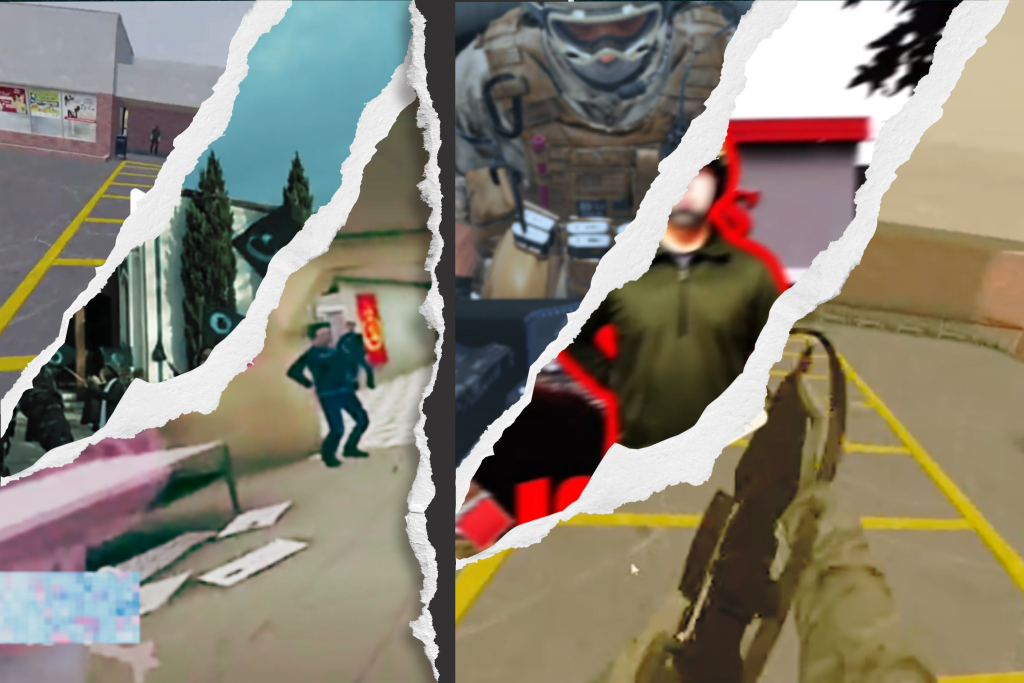
TikTok continues to platform videos depicting far-right extremist mass attacks despite repeated warnings and its own rules. In its latest investigation, GPAHE identified videos of the virtual reality game BONELAB being used to recreate elements of two deadly, real-world white supremacist attacks: the 2019 Christchurch mosque attacks in New Zealand, in which Brenton Tarrant murdered 51 Muslim worshippers, and the 2022 Buffalo, New York, supermarket shooting in the United States, in which Payton Gendron murdered 10 Black people.
This content circulates within TikTok’s broader True Crime Community (TCC), an online fandom centered on mass killers. TCC’s activities can include glorifying previous attackers and, in more extreme cases, encouraging further acts of violence. GPAHE has previously documented content glorifying mass attackers and far-right extremists on TikTok. However, the platform continues to host TCC-related content, including videos that use video games to simulate these acts of terrorism.
BONELAB, one of the games used for this purpose, was developed by the American studio Stress Level Zero and is available for Windows and Meta Quest, a line of standalone virtual and mixed reality headsets from Facebook parent company, Meta. Like many other video games, BONELAB supports modifications that allow users to introduce custom elements. However, these tools are also being used to recreate attacks associated with violent extremism and nihilistic violence.
Video Games and the Glorification of Extremist Violence
Violent extremists and hate actors have exploited gaming environments to disseminate propaganda, recruit individuals, and fundraise for their activities. These tactics range from creating games that explicitly promote ethnic cleansing and hateful ideologies to exploiting in-game chats to groom users and spread ideological messages.
Research has also highlighted the role of “gamification” in the relationship between gaming and violent extremism. Gamification refers to the use of game-design elements outside gaming contexts. Extremists have, for instance, used virtual leaderboards to rank attack-related body counts and incorporated points and badges into these contexts. The livestreaming of attacks also contributes to this dynamic when perpetrators frame violence as a spectacle or incorporate gaming-related language and imagery into its presentation.
In 2024, Turkish attacker Arda Küçükyetim stabbed five people near a mosque in Eskişehir, Turkey, livestreaming the attack. His manifesto explicitly gamified far-right violence by assigning points to actions such as killing and injuring people. It also ranked potential targets by difficulty, describing locations such as schools, places of worship, and parks as “levels” to be completed, turning planned acts of violence into a scoring system.
One of the most prominent examples of gamification in extremist violence is the 2019 Christchurch mosque attacks. Brenton Tarrant published a manifesto outlining his extremist views and posted a message on 8chan announcing the attack and linking to his planned livestream. He then broadcast the murders on Facebook using a helmet-mounted camera, producing first-person footage resembling the perspective of a player in a first-person shooter (FPS) game. This presentation of real-world violence echoed the first-person perspective familiar to video game audiences.
The 2022 Buffalo shooting provides another example. Payton Gendron, who deliberately targeted the Tops Friendly Market, a supermarket in a predominantly Black neighborhood of Buffalo, New York, was inspired by the Christchurch attack. He also livestreamed his murders, this time on Amazon-owned Twitch, a livestreaming service popular for video game content, and shared his manifesto outlining his racist ideology in a private chat on Discord, a platform widely used by gaming communities.
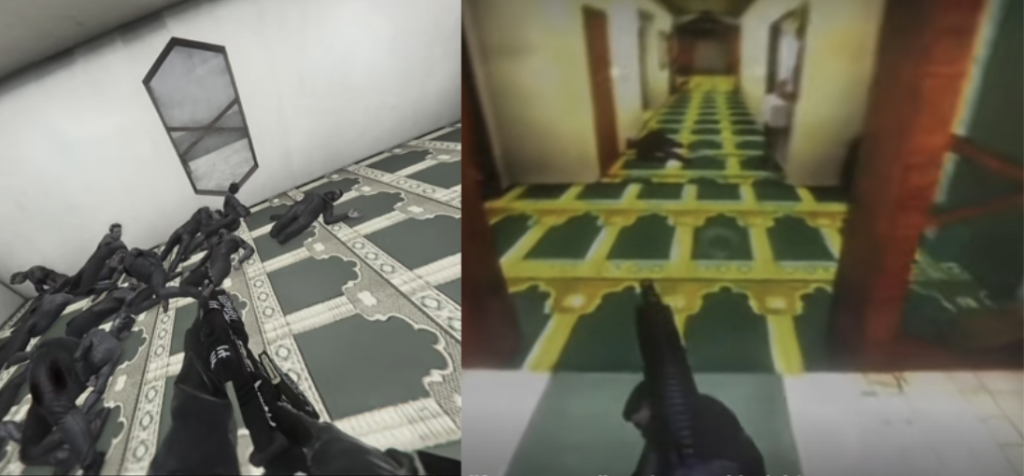
Two BONELAB videos recreating the Christchurch attacks (Source: TikTok).
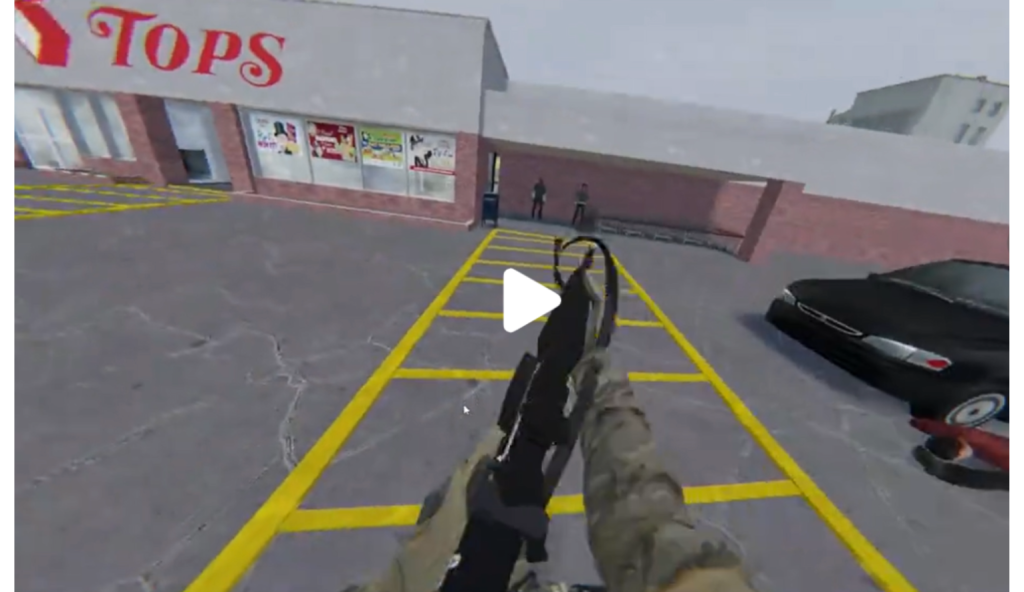
BONELAB video recreating the Buffalo shooting. (Source: TikTok).
The Christchurch mosque attacks and the Buffalo shooting were terrorist attacks rooted in racist and white supremacist ideology, particularly the Great Replacement conspiracy theory, which falsely claims that white or European-descended populations are being deliberately replaced by non-white populations through mass immigration, often framed as a Jewish plot. Both perpetrators incorporated neo-Nazi and white supremacist symbolism, and allusions to previous attackers. Much of this imagery was painted in white on the weapons they used. Such inscriptions on weapons and ammunition are common among extremist attackers and serve as symbolic expressions of ideology and affiliation with a broader extremist milieu.
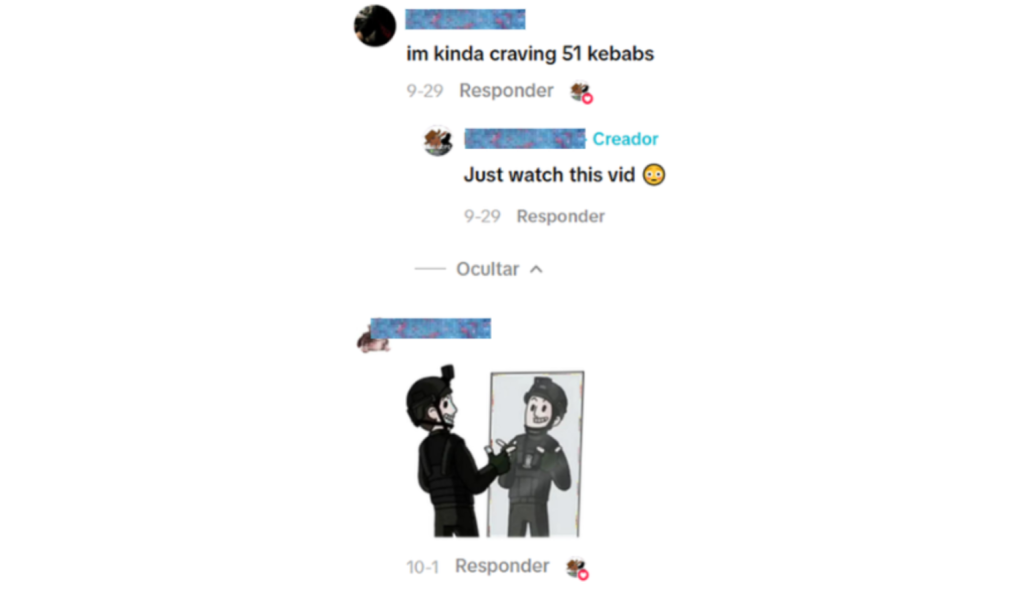
Hateful messages referencing the Christchurch attack under one of the BONELAB videos. “51 kebabs” refers to the 51 people killed by Brenton Tarrant and is a commonly used racist expression within the True Crime Community and white supremacist online spaces. (Source: TikTok).
The BONELAB videos identified by GPAHE on TikTok reproduce some of these symbols and inscriptions. These include the number “14,” which refers to the so-called “14 Words,” a slogan coined by neo-Nazi David Lane: “We must secure the existence of our people and a future for white children.” Other weapons feature swastikas, the inscription “kebab remover,” a reference to Tarrant’s anti-Muslim hatred, and the name of Dylann Roof, who murdered nine Black congregants in a 2015 Charleston, South Carolina, church shooting. The players’ clothing also features the Sonnenrad, or Black Sun, a symbol used in neo-Nazi circles, displayed on tactical vests.
Similar imagery has appeared in more recent attacks. During the 2025 attack on the Islamic Center of San Diego, 18-year-old Caleb Vazquez and 17-year-old Cain Clark appeared to wear clothing bearing versions of the Sonnenrad and inscribed their weapons with names and slogans. They also livestreamed the attack, and their manifesto referenced Christchurch attack.

Three different BONELAB videos showing weapons with inscriptions and symbols associated with violent extremism. (Source: TikTok).
The BONELAB videos recreate not only the weapons and clothing, but also the places where they took place. Players enter a virtual version of Al Noor Mosque in Christchurch, where details such as the prayer carpet reproduce the mosque’s interior. They also approach Tops Friendly Markets in Buffalo, recognizable by its distinctive red storefront sign, before entering a supermarket whose aisles and shelves have been recreated inside the game. Inside both locations, players shoot and kill people, with victims in some videos even pleading for their lives before being killed.
GPAHE also identified TikTok videos featuring BONELAB simulations of attacks on schools and spaces associated with social activism. Some of these videos depict settings marked by LGBTQ+ flags or Black Lives Matter imagery. These examples raise a distinct concern: the use of immersive gaming environments to simulate violence against spaces associated with LGBTQ+ communities and racial justice movements could potentially persuade users that these communities should be targeted and also provide ideas on how to carry out these attacks against groups.
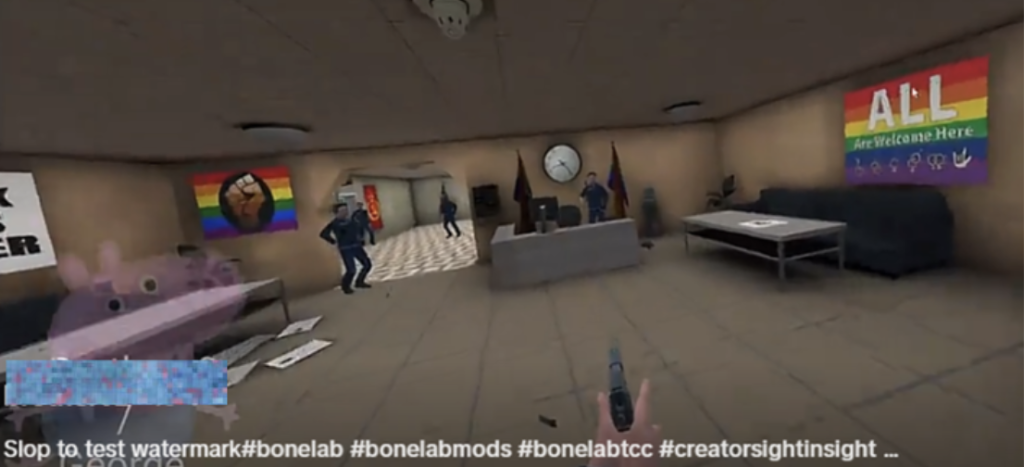
BONELAB video depicting a community space featuring LGBTQ+ and Black Lives Matter flags. (Source: TikTok).
Identity fusion
One particular concern at the intersection of gaming and violent extremism is identity fusion, a process in which a person’s sense of self becomes closely intertwined with their identification with an online group. In gaming environments, players may develop strong psychological and emotional connections to the people in their gaming community, in-game character, or avatar. The sense of belonging and shared identity that games can foster are particularly concerning in the context of online radicalization, especially when combined with the exclusionary “us vs. them” narratives commonly found in extremist ideologies.
In this context, the BONELAB videos identified by GPAHE merit specific attention. By faithfully recreating the circumstances, locations, and weapons involved in previous violent extremist attacks, the videos allow users to experience such scenarios in virtual reality, as if they are really there and conducting the attack themselves. These immersive experiences present the risk of strengthening gamers’ identification with the perpetrators and the violence they reenact.
These concerns are particularly relevant when considering real-world cases in which online gaming communities and school violence intersect. In August 2021, 15-year-old Hugo Jackson carried out a knife attack on a teacher at a school in Eslöv, Sweden, livestreaming the incident using a camera mounted on his helmet. Jackson had met another teenager through the online video game Roblox around six years earlier. In January 2022, that teenager carried out a knife attack at a school in Kristianstad, Sweden. The two reportedly considered themselves “blood brothers” and shared an interest in Nazi ideology and mass violence, including discussions about the livestream of the 2019 Christchurch mosque attacks.
More recently, a series of knife attacks and threats targeting educational institutions in Poland has raised similar concerns. Among these incidents, a 15-year-old former student fatally stabbed a school caretaker and injured two teachers while reportedly wearing a helmet-mounted camera to record the attack. In another case linked to this wave of violence, police reported that a suspect had created a model of his school in Roblox and used it to simulate attacks on students. He was found in possession of a firearm, ammunition, and knives.
This intersection between gaming and school violence goes back decades. In 1999, Eric Harris and Dylan Klebold killed 12 students and a teacher at Columbine High School in Colorado before taking their own lives. Both were fans of the first-person shooter DOOM, and Harris created custom scenarios for the game. The two used DOOM to recreate the attack they would later carry out at their school.
From Gaming Creativity to Extremist Content: The Role of Modding
Modding, short for “modification,” refers to the process through which players or other members of a gaming community alter existing video games or add new content to them. These modifications, commonly known as mods, can include new weapons, maps, characters, avatars, and other in-game elements. While modding is a creative aspect of gaming culture that allows players to customize and expand their gaming experiences, it can also be exploited to introduce extremist content into games that do not originally contain it.
In the BONELAB videos identified on TikTok, GPAHE found that users frequently asked how to obtain the same weapons or maps used to recreate previous attacks, or discussed the accuracy of the elements depicted, including weapons and details of the locations. In many cases, users who posted the videos offered to share the associated mods through TikTok direct messages.

Comment asking about a weapon inspired by real-world violent extremist attacks depicted in the game. (Source: TikTok).
These modifications are also available on dedicated platforms such as Basedmods, which hosts mods depicting school massacres and violent extremist attacks for various video games. For BONELAB, for example, the platform hosts avatar modifications of Eric Harris and Dylan Klebold, the perpetrators of the Columbine High School massacre, and Vladislav Roslyakov, the perpetrator of the Kerch Polytechnic College massacre.

TCC-related avatars for BONELAB available on the Basedmods platform. (Source: Basedmods).
Modifications and related content are also discussed in gaming communities on Discord. In BONELAB-related Discord communities identified by GPAHE, users exchanged advice on obtaining mods that recreate attacks and on acquiring weapons. In one conversation, users discussed the inscriptions on the weapons used in the attacks, sharing images of Tarrant’s rifle, and identifying which inscriptions appeared on the original weapon. Elsewhere, users mentioned packs known as “TCC sounds,” which reportedly recreated the voices of the perpetrators of the Christchurch mosque attacks and the Buffalo shooting. On Discord, there are servers entirely dedicated to glorifying mass attackers, sharing their photos, and expressing admiration for them.

Discord messages expressing admiration for mass shooters such as Caleb Vazquez and Brenton Tarrant.
Modding is not exclusive to BONELAB. Modifications, as well as their use by hate actors, have also been documented in other games, including Call of Duty, Grand Theft Auto, Minecraft, and Roblox, several of which GPAHE has previously flagged. During this investigation, GPAHE also identified numerous Roblox videos on TikTok referencing the attacks carried out by Brenton Tarrant and Payton Gendron.
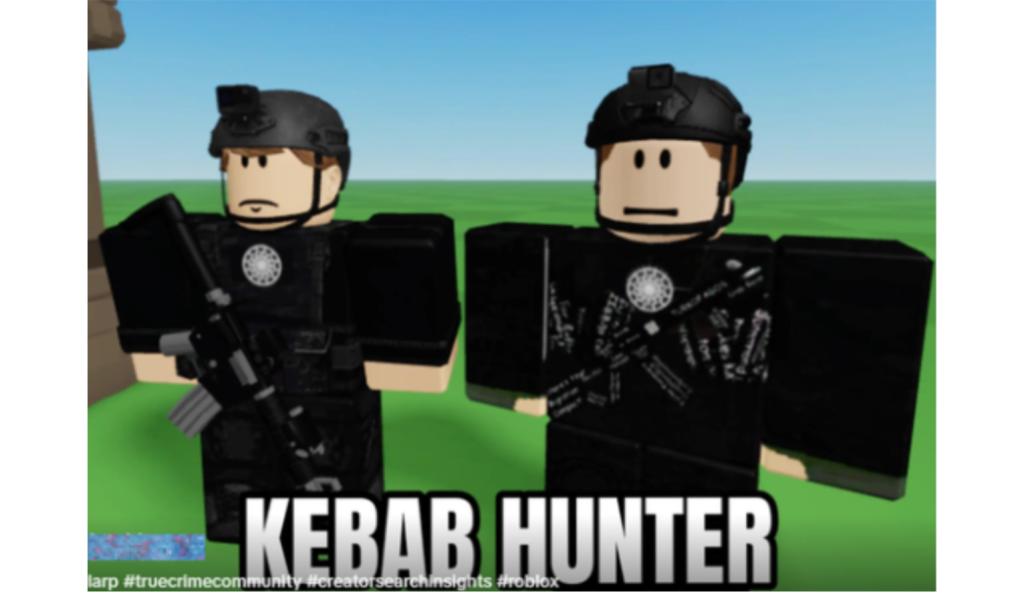
Roblox video featuring characters imitating the perpetrators of extremist attacks. (Source: TikTok).
BONELAB videos within TikTok’s wider TCC ecosystem
The BONELAB videos on TikTok are not an isolated phenomenon, but form part of a broader online ecosystem associated with the True Crime Community. Despite repeated warnings, TikTok continues to host various forms of TCC-related content, including “rampage dance” edits which consist of AI-generated videos depicting perpetrators of mass violence dancing while displaying the number of people they killed. Other AI-generated videos mock the victims by depicting attackers DJing at parties attended by their victims or recreating birthday celebrations with them.

Rampage dance edits featuring Brenton Tarrant and Payton Gendron dancing over images of their attack sites, with on-screen victim counts. (Source: TikTok).
Users who engage with content glorifying mass attackers and far-right terrorists are frequently exposed to video game simulations of their attacks. TikTok’s recommendation algorithm creates echo chambers in which users repeatedly encounter related content, leading them to discover BONELAB videos that recreate these attacks and allow them to experience them in virtual reality.
TikTok and other platforms should act now to protect their users from violence
Repeated exposure to content that glorifies perpetrators, mocks victims, or simulates attacks contributes to radicalization by normalizing extremist violence, reinforcing harmful ideological narratives, and increasing exposure to extremist propaganda. Recruiters exploit these dynamics to draw users into increasingly fringe online spaces, where they encounter more extreme content circulating in closed online communities and encrypted channels. These trends highlight the overlap between TCC fandom, gaming culture, and extremist communities, where the circulation of different forms of content reinforces the glorification and normalization of extremist violence.

One of the AI-generated videos mocking the victims of the Christchurch mosque shootings. (Source: TikTok)
TikTok’s Community Guidelines prohibit content that glorifies perpetrators of mass or serial violence, promotes hateful ideologies, or displays associated extremist symbols and materials. These rules are directly relevant to the content identified by GPAHE, illustrating TikTok’s continued disregard of its own standards and the safety of its young users. TikTok must move beyond written policies and take meaningful action to address its continued failure to enforce them, which allows real-world extremist violence to be recreated, glorified, and turned into entertainment on its platform. The same goes for the gaming industry and sites like Discord, where this material must come down.
