


Election deniers across the country have already started laying the groundwork to claim that any losses in the midterms are the result of widespread voter and election fraud. These claims are often parroted, or started, by members of the Trump administration, who see Trump’s continued grip on power as the only way they can avoid intense scrutiny, investigation, and accountability.
Since taking office, Donald Trump has ensured that election denialism is woven into the fabric of how Americans see our democracy. From the seizure of ballots to increasing pressure on states to quickly purge voter rolls, the administration has pushed this issue at every turn. He even appointed election deniers to key positions in the administration, many of whom have used their power to sow distrust in the election system.
The narratives captured here are some of the most popular, but by no means is it an exhaustive list of the ways some may try to subvert the election results. This article is designed to arm you with the truth behind these mostly outlandish, and false, claims.
Claim: State Voter Rolls Are Full of Noncitizens, making it Easy to Commit Voter Fraud
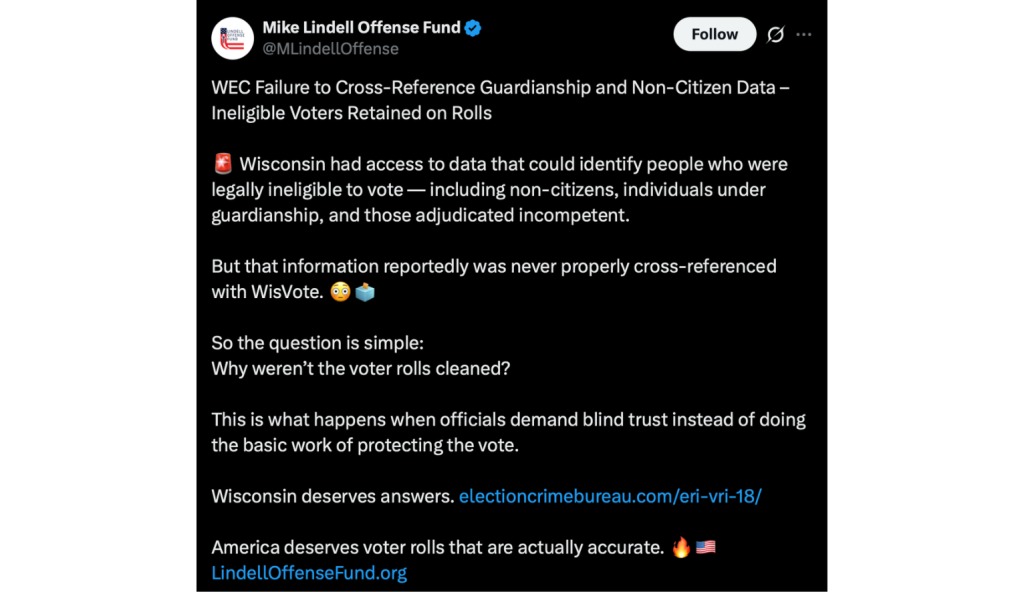
A post from the account of the Mike Lindell Offense Fund, an election denial organization founded by former MyPillow CEO Mike Lindell. (Source: X).
The Trump administration has spent the better half of the past decade promoting the idea that state voter rolls are full of noncitizens and deceased people, making it easier for individuals to commit fraud. In Trump’s second administration, the Department of Justice (DOJ), led by Assistant Attorney General for Civil Rights and prominent election denier Harmeet Dhillon, sued 30 states and the District of Columbia for access to their voter rolls.
Courts have not been receptive to the Trump administration’s claims. As of October 15th, judges have rejected over two dozen of those lawsuits, citing a misinterpretation of the federal government’s role in the administration of elections, which the Constitution squarely leaves to the states. The goal? To run those rolls through federal databases and press states to remove anyone flagged as a potential “noncitizen.”
Even without the full voter rolls, the Trump administration has attempted to run names through databases, often announcing exaggerated numbers of noncitizens on state rolls. The administration uses the Department of Homeland Security’s (DHS) Systematic Alien Verification for Entitlements (SAVE) system.
What the administration fails to acknowledge, is that there are problems with SAVE, and it frequently returns outdated or false information about citizenship status. The Brennan Center says that because of these issues, “the information gleaned from the SAVE program should be considered useful, but not definitive in assessing an individual’s citizenship.”
In July, the president and DHS Secretary Markwayne Mullin alleged they had found 270,000 noncitizens across voter rolls in Nevada, California, New Jersey, and Pennsylvania. When the state of Nevada asked questions, they were given a list of 185 names. Deputy Attorney General of Nevada Greg Ott responded after the state conducted a review by writing, “As for the 185 individuals, our records indicate that they were citizens…You have provided nothing of substance to suggest otherwise.”
Texas ran its entire voter list through SAVE and it flagged 2,724 voters as potential noncitizens. A press release from the Texas Secretary of State revealed that roughly 20% of those flagged were flagged incorrectly, and the state only referred 4.2% of those flagged for investigation. Boone County, Missouri did the same thing, and found that more than half of the individuals SAVE flagged were citizens.
In California, the DOJ accused the state of allowing some 20,000 noncitizens on their voter rolls, and demanded the state take the unprecedented step of segregating their ballots. California says they have reviewed the list, and that their records indicate many on the list were born in the U.S. and may be citizens. The DOJ is currently suing the state to investigate the 20,000 people before their votes are counted, which the state says is unreasonable this close to the election.
Claim: Noncitizens Are Voting En Masse

A post about the arrest of a noncitizen voting by DHS Secretary Markwayne Mullin. (Source: X).
There is also the constant insinuation that there are hundreds of thousands of noncitizens voting in U.S. elections. Trump began claiming that noncitizens were voting in large numbers in 2016, attributing his loss of the popular vote in the presidential election to the phenomenon. In recent months, the administration has revived this narrative to cast doubt on the 2026 midterms before they even begin.
DHS Secretary Markwayne Mullin posted about a recent arrest of a noncitizen who voted in 2026, writing: “When even one non-citizen votes in our elections, it steals the vote of an honest, hard-working American citizen. It’s also AGAINST the law. If we catch an alien illegally voting in our elections, we will hunt you down and arrest you. The Trump Administration will always defend the integrity of our election system, and we will make sure that only American citizens are electing American leaders.”
Both DHS and the FBI have spent enormous resources and time attempting to prosecute the supposed “high numbers” of noncitizens who are voting or have previously voted in the U.S. elections. Even with this push, voting by noncitizens is incredibly rare, and a substantial number of charges do not result in a conviction.
According to recent research conducted by Reuters, case records show that federal prosecutors have charged just 129 people under a federal “voting by aliens” statute created by Congress in 1996. More than two-thirds of those prosecutions – 86 – have been filed during Trump’s total five-and-a-half years in office. In none of the cases did prosecutors allege a coordinated effort to influence an election. And no defendant was accused of being paid to vote. Instead, many appear to stem from voter confusion, miscommunication with election officials, or administrative errors.
The Center for Election Innovation and Research (CEIR) found that sweeping allegations about possible noncitizen registration or voting appear to arise from misunderstandings, mischaracterizations, or outright fabrications about complex voter data. Even an analysis of the data published by the far-right think tank The Heritage Foundation found only 77 cases of noncitizen voting between 1999 and 2023, each of which was investigated by the appropriate authorities.
In New Jersey, where a software error registered thousands of non-citizens to vote, only 400 voted in 2023 and 2024, according to an announcement from New Jersey Governor Mikie Sherrill’s office. Those 400 people represent around .02 percent of votes cast in the 2023 state elections and .009 percent of votes cast in the 2024 presidential election.
Claim: Mail-In Voting is Inherently Fraudulent

A post from election denier Scott Pressler encouraging people to report “non-citizen voting, mail-in ballot fraud, or any other election issues.” (Source: X).
Trump has been attacking mail-in voting since 2020, when he blamed it for his loss to Joe Biden. In August 2025, Trump pledged to issue an executive order ending the use of mail-in ballots. The order, which he signed in March, directed the U.S. Postal Service to block the delivery of ballots to voters who were not on a Trump-approved list. The Supreme Court blocked the order from taking effect before the midterms. That did not stop Trump from claiming that the ruling “gives people more time to vote illegally.” Nor did it dissuade him from pursuing this order in time for the 2028 elections.
In February, Elon Musk cited a post arguing that mail-in voting should be curtailed, and Trump amplified it. The post recycled a debunked claim that Pennsylvania mailed out about 1.8 million ballots in 2020 but got back roughly 2.5 million. The figure conflates primary and general election data, and the issue has been corrected repeatedly since 2020. In June, as California counted its primary election ballots, an image of a blue-haired woman stuffing a stack of ballots into a drop box spread across social media, captioned as a “California voter” committing fraud. It was generated with AI. The image still carried a Gemini logo (Google’s AI tool) in the corner, and the sign on the box was full of misspelled and gibberish words.
In September, the DOJ joined in, announcing an indictment of a Utah postal worker who dumped mail, including roughly 300 primary ballots, in a church parking lot dumpster. The carrier said he wanted to lighten his workload. In October, a video circulated by Valley Center Republicans and Amy Reichert, a former San Diego County supervisor candidate, claimed 27 “lost and stolen ballots” had been found strewn along a road in San Diego County. According to the University of Washington’s Center for an Informed Public, only 12 discarded ballots were found in the end. A resident collected the materials and brought them to the post office, and the Postal Service redelivered them to voters.
The truth is that voting by mail is a heavily safeguarded part of the election system. Ballots are only supposed to go to registered voters, and returned envelopes are checked against signatures or ID numbers on file. Many states let voters track their ballot by barcode from mailing to counting, and every ballot leaves a paper record that can be audited. Trump himself has voted by mail in multiple elections, as his official residence remains in Florida. Several deep-red states, including Utah, run their elections almost entirely by mail, without complaint from the Republicans they elect.
Claim: Electronic Voting Machines are Easily Manipulated/Being Manipulated by Foreign Countries

A post from the official White House account on X spreading false claims about election fraud. (Source: X)
This claim is another favorite of the President. After 2020, Trump and his allies expended significant effort and money toward disparaging certain electronic voting companies. The situation got so bad that one company, Dominion Voting Systems, sued the President’s lawyer, Rudy Giuliani, among others, for the claims.
Now back in office, the Trump administration has taken these claims even further. Director of National Intelligence Tulsi Gabbard’s office obtained and examined voting machines in Puerto Rico, and Gabbard was present at the FBI’s January 28 raid on Fulton County’s election center, where agents seized 2020 ballots. Her office has never said what foreign threat justified either move, and she left office in June.
Allegedly, Trump’s appointees even went so far as to ask officials from DHS’ Cybersecurity and Infrastructure Security Agency (CISA) in early 2025 to acquire an electronic voting machine, examine it, hack it, and report those findings directly to the White House. ProPublica, the first to report on this story, wrote that the CISA employees were deeply concerned because they had been directed not to alert the voting machine company if it uncovered flaws, contrary to its standard practices.
Election denier Tina Peters, the former Mesa County, Colorado, clerk who was convicted of tampering with voting equipment, met with Trump at the White House this month. She and election denier Cleta Mitchell have pushed a plan that involves Commerce Secretary Howard Lutnick seizing, investigating, and potentially replacing, state voting machines before the midterms. Senators have warned that the administration may use the pretext of foreign interference to impound machines or seize ballots in close races if Democrats win.
This claim remains as untrue as it was in 2020. While there are security gaps in electronic machines, there has been no reason to suspect that these security issues had any material impact on election results. Security experts are concerned that without acknowledging that nuance, the security gaps will be weaponized to question the results of an election.
Michael Moore, chief information security officer for the Arizona Secretary of State’s office, said that the conversations security experts are having about vulnerabilities are being “ceded to people who want to weaponize it.”
Claim: “Vulnerable Voters” are Being Forced to Vote for Liberal Candidates Against Their Will

A post from the election denial organization Election Integrity Network spreading a false claim about the manipulation of “vulnerable voters.” (Source: X).
This claim is not as prominent as some others on this list but is nonetheless becoming a popular one ahead of the upcoming election. In 2020, Trump claimed that thousands of “crooked” votes were cast in a Wisconsin nursing home. The claim was unfounded, but many individuals in Trump’s sphere of influence view nursing homes as hotbeds of illegal voting.
This narrative is also prominently shared by the Election Integrity Network (EIN), an election denial organization founded by Cleta Mitchell. EIN has shared numerous posts in recent weeks alleging a variety of elder voters were manipulated into voting in their nursing homes. Mitchell made an appearance on Steve Bannon’s “War Room” podcast to promote these claims, saying liberals “go into nursing homes, and they go into group homes, and they basically steal the votes of these most vulnerable people.”
EIN went as far as to share their own “Protecting Vulnerable Voters,” toolkit, which details their interpretation of federal law for caretakers. The Department of Health and Human Services issued similar “guidance” in July, “reminding facilities and their staff that they cannot engage in inappropriate coercion or other violations of residents’ rights.” Mitchell made it clear that this effort was to ensure that “the wrong people don’t get elected.”
Coercing a nursing home resident to vote a certain way is already a crime, and when it happens, which is rarely, it frequently gets caught. Mitchell’s favorite example, a Michigan nursing home worker jailed for voter fraud, was immediately flagged by a local clerk who compared signatures. The existing safeguards worked exactly as designed.
There is also concern from multiple parties that this new guidance could disenfranchise nursing home patients, as the aides or employees may be too scared to lawfully help them fill out and return their ballots. A group of U.S. Senators sent a letter to the Center for Medicaid and Medicare Services urging them to rescind the memo, saying it was an effort to intimidate nursing home workers away from helping residents legally cast their votes.
