

More than 96 people suffered injuries after explosions rocked Friday prayers at a school mosque in Jakarta, Indonesia.
The attack took place in the Kelapa Gading district of the capital city on November 7. A 17-year-old student at the school has been identified as the alleged perpetrator.
Details remain sparse at this point about the alleged attacker, but the limited information available shows a connection to violent internet subcultures. The alleged perpetrator also reportedly brought a realistic looking airsoft rifle to the school that had a neo-Nazi slogan on it and the names of white supremacist killers who targeted Muslims and other minorities.
Taking place at SMA Negeri 72, a public high school, two explosions were initially reported occurring around 12:09 local time, according to the Indonesian national news agency Antara. One detonated inside the mosque, while the second was near the school’s rear gate. Other reporting from local sources indicates the alleged perpetrator may have also targeted three locations: the prayer room, a canteen, and an area where students gather.
In total, police report finding seven explosive devices linked to the attack.
Jakarta Metropolitan Police’s Public Relations Bureau head, Senior Commissioner Budi Hermanto reported that 29 people were hospitalized due to the blasts. Three individuals sustained serious injuries and two, including the perpetrator, required surgery.
Video recorded at the scene shows what appears to be an explosive device or firework laying on the floor and the damage done to the building. In other footage, smoke is seen billowing out of a nearby building and a group of individuals in student uniforms carrying what appears to be a victim away from the site.

A screen capture of a potential explosive device shown in the aftermath of the incident at SMA Negeri 72.
Police reported finding replica firearms and handwritten materials believed to be linked to the explosions.
Images of a pistol and rifle have been released by local news agencies. Though the weapons appear to be airsoft—meaning they only shoot small plastic pellets—they nonetheless were covered in names and phrases associated with previous mass attackers and white supremacy.
White writing on the black rifle references Brenton Tarrant, the perpetrator of a 2019 massacre in Christchurch, New Zealand. Tarrant killed 51 people at two mosques, live streaming the carnage on Facebook as it unfolded. The rifle also had the names of “Alexandre Bissonnette,” the perpetrator of a 2017 shooting at a Quebec, Canada, mosque that killed six people, and “Luca Traini,” an Italian man who shot and wounded six African men in 2018.
The weapon also contained the phrase “14 words,” a racist slogan (“We must secure the existence of our people and a future for white children”) coined by American white supremacist terrorist David Lane. It also had inscribed, “For Agartha,” a reference to a mythological city, sometimes thought to be in the center of planet, linked to Western esoteric beliefs. Previously of particular interest to members of the German Nationalist Socialist movement, in internet culture Agartha is often linked to the idea of the mythical Aryan homeland Hyperborea.
It also contained the number “1189,” which is the year the Third Crusade began, and the St. Michael’s Cross, a grid pattern designed by Romanian fascist Corneliu Codreanu, the leader of the “Iron Guard/Legion of Saint Michael” in the early 1900s.
Other inscriptions read, “Welcome to Hell.”
Online Footprint
Images shared of an injured male allegedly show the perpetrator after the attack. Bleeding from his head, the person in the picture is wearing a shirt reading “Natural Selection” in stenciled black lettering. This is the same style shirt worn by one of the Columbine school shooters, Eric Harris.
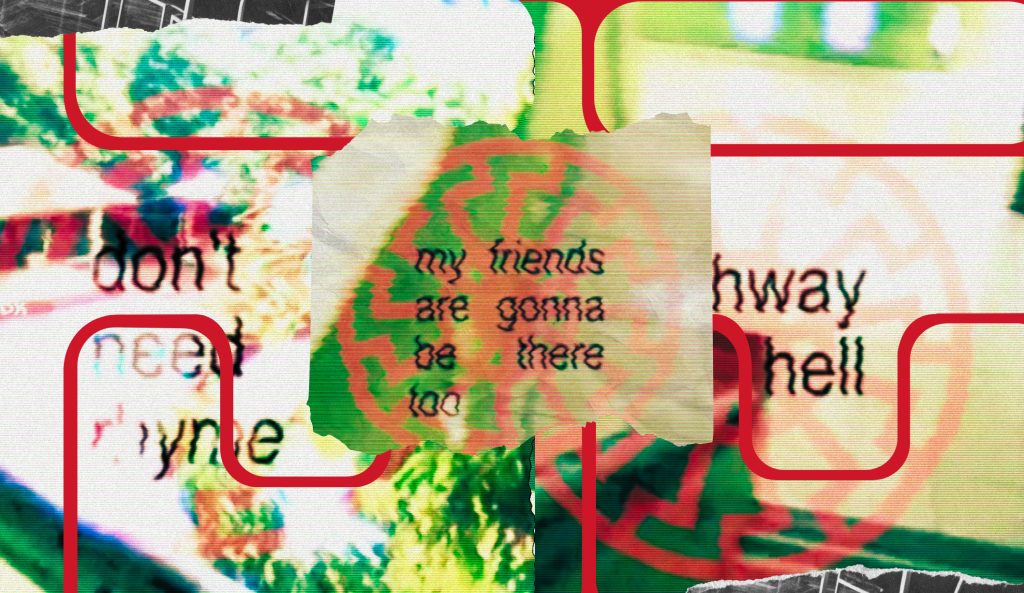
Archived footage from a since-suspended TikTok account appears to offer insight into the perpetrator’s possible motivations (the footage has not yet been independently verified as belonging to the attacker). In one video, a courtyard is visible with an image of a Sonnenrad, a symbol associated with National Socialism and neo-Nazi movements, spinning as AC/DC’s “Highway to Hell” plays.
The footage is slightly distorted with a video filter, but the Global Project Against Hate and Extremism (GPAHE) has compared the footage to other video taken inside the courtyard of the school where the attack took place. Both images have distinct architectural and natural details that suggest a high likelihood that these depict the same building. This includes the tree line, relative location of buildings in the area, and the style of roof tiles shown in both videos (see image comparison below).
Other items shown in the three available TikTok videos include a combat harness and boots similar to items pictured near the attackers body.

Image comparison between footage shared to a TikTok account likely belonging to the alleged perpetrator and footage taken on the day of the attack on the school. (Source: TikTok)
In another TikTok post, shared the day before the attack, a picture shows a hand making the “OK” sign and the photographer’s boots. This is likely an homage to several past killers, who posted similar images before carrying out their own school shootings. These include Natalie Rupnow, who killed two people and herself at Abundant Life Christian School in Madison, Wisconsin, and Solomon Henderson, who killed one person and himself at Nashville, Tennessee’s Antioch High School.
Breeding Violence
In the “OK” video on TikTok the hashtag “teeceecee” and “TCC” have been added. Standing for True Crime Community, the TCC is a network of podcasts, articles, and web forums with a significant presence on most social media platforms including Tumblr, Reddit, TikTok and X, dedicated to exploring particularly brutal crimes and the criminals who perpetrate them.
Often this involves the sharing of footage, images, and other media related to notable killers. Parts of this network are deeply focused on amassing gore videos and share graphically violent and disturbing content, particularly of violent criminal activity. Other parts of the network actively encourage others to undertake their own attacks.
Diffuse and decentralized digital networks can be difficult to map and understand, but online communities that worship at the altar of mass killers have existed online for decades. Observed during the aftermath of the Columbine school massacre, obsessive fandoms emerged pouring over the perpetrators, their motivations, and the writing and videos recorded before the attack.
These communities include the Terrorgram network. Made up of a series of white supremacist channels and chatrooms on the social media application Telegram, Terrorgram elevated the perpetrators of mass casualty attacks to the status of “saints” and placed them in a pantheon of killers that had committed lethal violence in the name of protecting the white race.
This subculture has grown significantly, now including other attempted and successful murderers.
Antioch High School shooter Henderson, who referenced the TCC in his manifesto, was part of a network of image board users sometimes referred to as Soyjak Attacker Video Fandom (SAVF). Rupnow had a Telegram invitation to the same chat room where Arda Küçükyetim, a mass stabber in Türkiye who injured five people in a tea garden in August 2024 before attempting to flee on foot, was active. He was dressed in tactical gear and a half-skull mask and had posted his manifesto and links to a live stream of the attack. He injured five people.
Küçükyetim cited the “Terrorgram Collective,” a group within the Terrorgram network, as partly inspiring his attack in a manifesto, while researchers tied him and an unidentified online accomplice named “Hansen” to the SVAF.
Networks like Terrorgram and SAVF share large amounts of content related to mass casualty attacks, including explicit videos and images of the attacks themselves and the aftermath. While parts of the TCC condemn violence, distinct features of networks like SAVF include encouraging others to carry out their own attacks.
Unlike many extremist networks, race, gender and background are not a limiting factor within the TCC network. These extremely online and macabre young people display a deep affinity for a variety of killers from different backgrounds and motivations. Unlike Terrorgram, networks like TCC and SVAF—which could be considered a subset of the TCC—are not primarily motivated by ideology, but rather by social standing in their community. This means that despite individuals active in these spaces lionizing mass shooters who cite white supremacy as their motivation, and a large amount of racism existing within the online spaces they use to share graphic content and communicate, the networks are often made up of individuals of surprisingly diverse backgrounds and ethnicities.
